
The Two Elements of an AI Data Platform, and Why the Market Is Evolving to Create “Data Fabric 2.0”
After reviewing a few recent mergers and acquisitions by some of our largest partners, it hit me that our team has had a five-year head start on what has turned into the “AI Data Platform” challenge.
Today, “AI data platform,” or AIDP, shows up on nearly every storage vendor’s homepage. For us, the conversation started much earlier, and it didn’t start with AI. It started with a common issue among our largest customers: users could not easily share data with each other and needed a “data fabric” to simplify access and create cost efficiencies.
The problem: research done twice, or many, many times
Roughly five or six years ago, we began working with a key large-scale client on what we now call data fabric problems. The driver was data sharing.
In a high-security environment, data tends to get locked into the system, site, or enclave where it was created, often for good reasons. Sometimes it is funding: I have funding for project X, which includes storage, so that is another silo. Then there is cloud. Cloud file storage and cloud file services can create several more silos on their own.
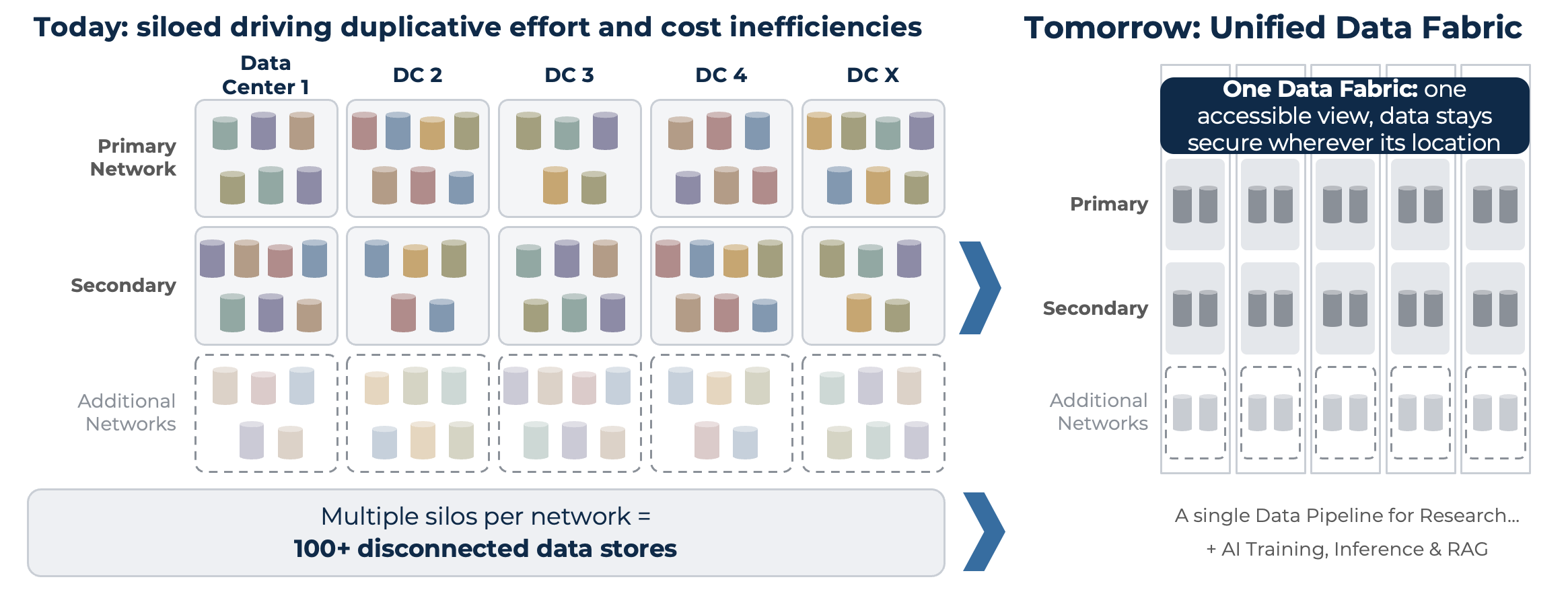
A side effect is inefficiency. When users or researchers can’t find or reach data that already exists, they redo the work. They rerun the experiment, regenerate the dataset, or rebuild the model. That costs time, effort, and energy nobody has to spare. And the cost of that inefficiency comes with a second consequence: incomplete or imprecise results, the opposite of the required outcome.
If you run IT for a state agency, a university research computing group, or a federal lab, you probably recognize the pattern. The data exists. It’s just in the wrong place or behind the wrong boundary. So people make another copy, and then another. Here is a typical example for a hypothetical customer environment with multiple networks or classification levels:
The usual answers we saw in the past were to implement a data fabric with NetApp on the enterprise side,
or HPE Ezmeral and IBM on the research side.
What we tested, and where we landed
Over several years we researched, evaluated and then tested the best technologies against the problem, typically including NetApp, Dell’s Isilon, Weka and HPE Ezmeral Data Fabric (now sold as HPE Data Fabric Software). We also brought a long history with IBM Spectrum Scale, the parallel file system formerly known as GPFS and now called IBM Storage Scale. These are the industry’s most capable platforms, and each one taught us something about what our customer actually needed.
As requirements evolved, after each successful test, we eventually found Hammerspace. We deployed it at relatively large scale, replacing some legacy systems and laying the foundation for data fabrics both across multiple data centers and across the data sets within each of them.
Now that we have used a number of the best platforms to solve these problems, the AI revolution has poured gas on the fire. A top reason AI projects fail is lack of data readiness: access, and data hygiene. NetApp first educated me on this a couple of years ago (shout out to Cecile!) for a higher ed customer.
Then the noise got loud about “AI Data Platforms”
By NVIDIA GTC 2026, you couldn’t avoid the topic of AI Data Platforms from any storage vendor. Organizations are spending enormous sums on AI infrastructure, and they’re discovering that GPUs are only as useful as the data you can feed them.
The bigger realization is about copies. The old reflex was to pull data out of where it lives, copy it into a new environment for training, and call that the AI pipeline. Do that a few times and you’ve built a new set of data silos, each a little out of date and each another thing to secure. The smarter move is to bring your data to AI, in place and governed.
The two elements of an AI data platform
Based on what we have seen over the last several years, whether for the researcher use case or for an AIDP, your data platform needs two elements working together:
- A high-performance (usually parallel) file system. This is the muscle. GPUs and HPC clusters are hungry, and a parallel file system lets many compute nodes read and write data at the same time, fast enough to keep expensive accelerators busy. These are easy to find.
- A data unification and orchestration layer. This is the intelligence that knows what data you have, where it lives, who is allowed to use it, and where it needs to be next. It finds, prepares, places, and moves data according to policy, so the right data reaches the right compute without someone attempting, poorly, to move and manage copies around a non-orchestrated environment.
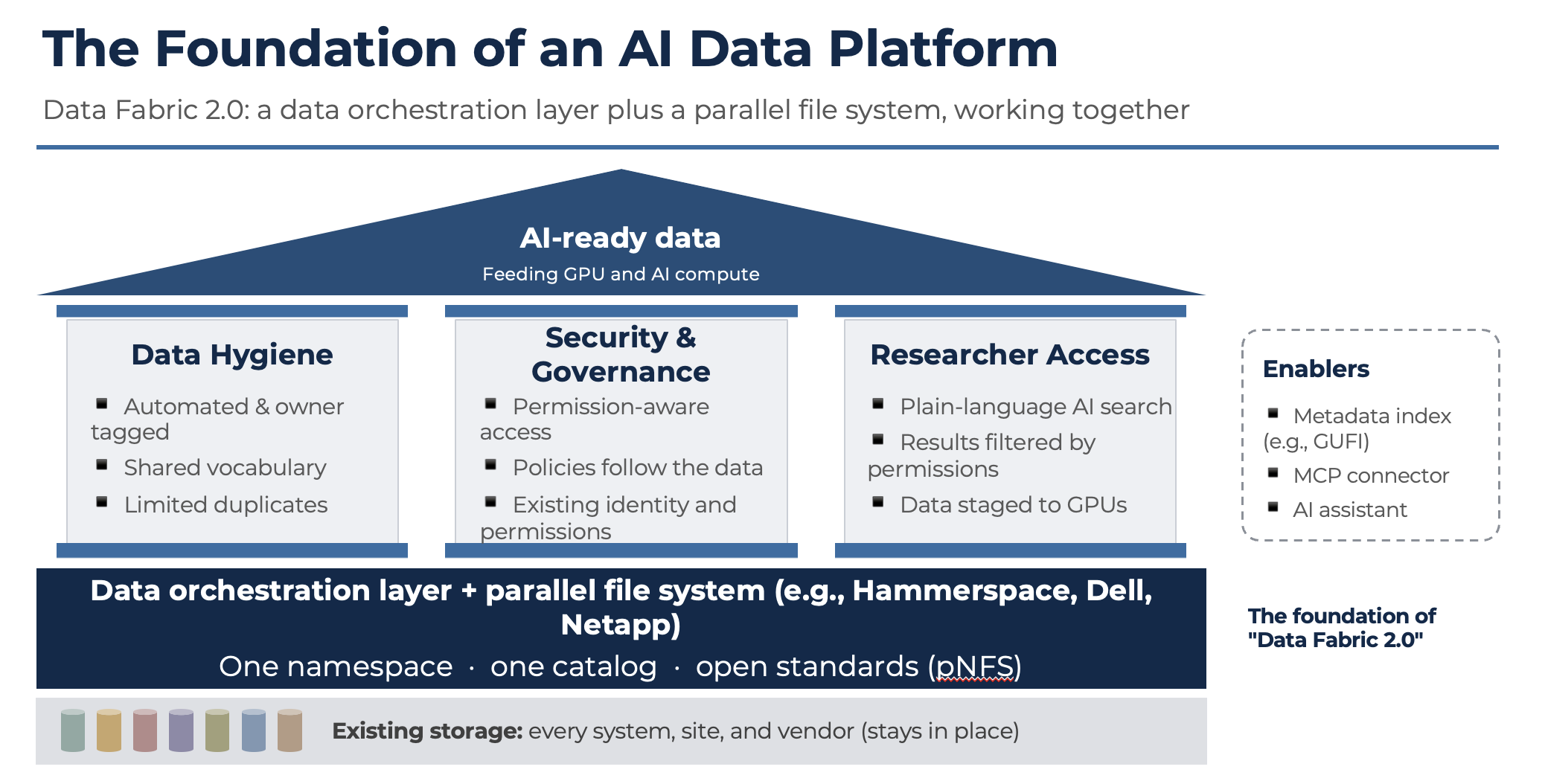
Once these two foundational elements are in place, adding data hygiene, security, and access is straightforward. The foundation is what is missing in most organizations, and it is what we have been focused on for years.
Do this right and you can massively speed up curation: cleaning, securing, tagging, all the prerequisites to AI development and research in larger deployments.
In our view, Hammerspace led the charge here. Its platform pairs policy-driven data orchestration across existing storage, sites, and clouds with a standards-based parallel file system built on parallel NFS (NFSv4.2 with Flex Files), using the client that already ships in the Linux kernel. From our hands-on experience deploying it, Hammerspace is well integrated across those two elements, which can be extremely powerful. That’s a practitioner’s judgment from real deployments, not a benchmark, and every environment is different.
These two functional elements together are what we are calling Data Fabric 2.0, or DataFab for short. And now the world’s largest storage providers have thrown down their proverbial hammer, validating the market need for both elements of an AIDP.
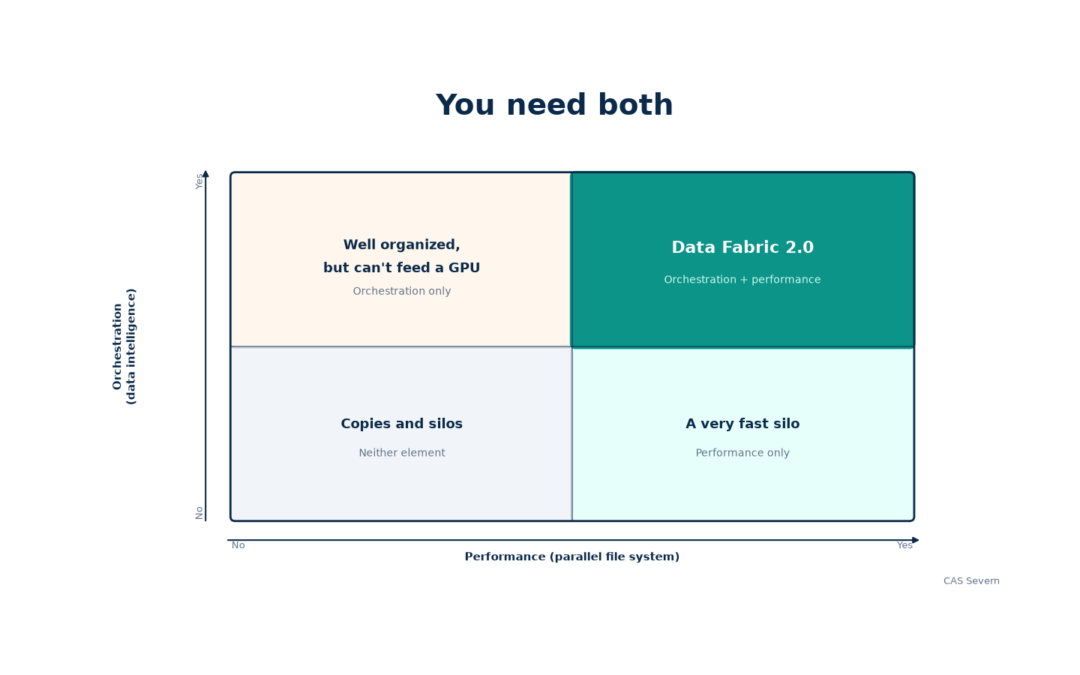
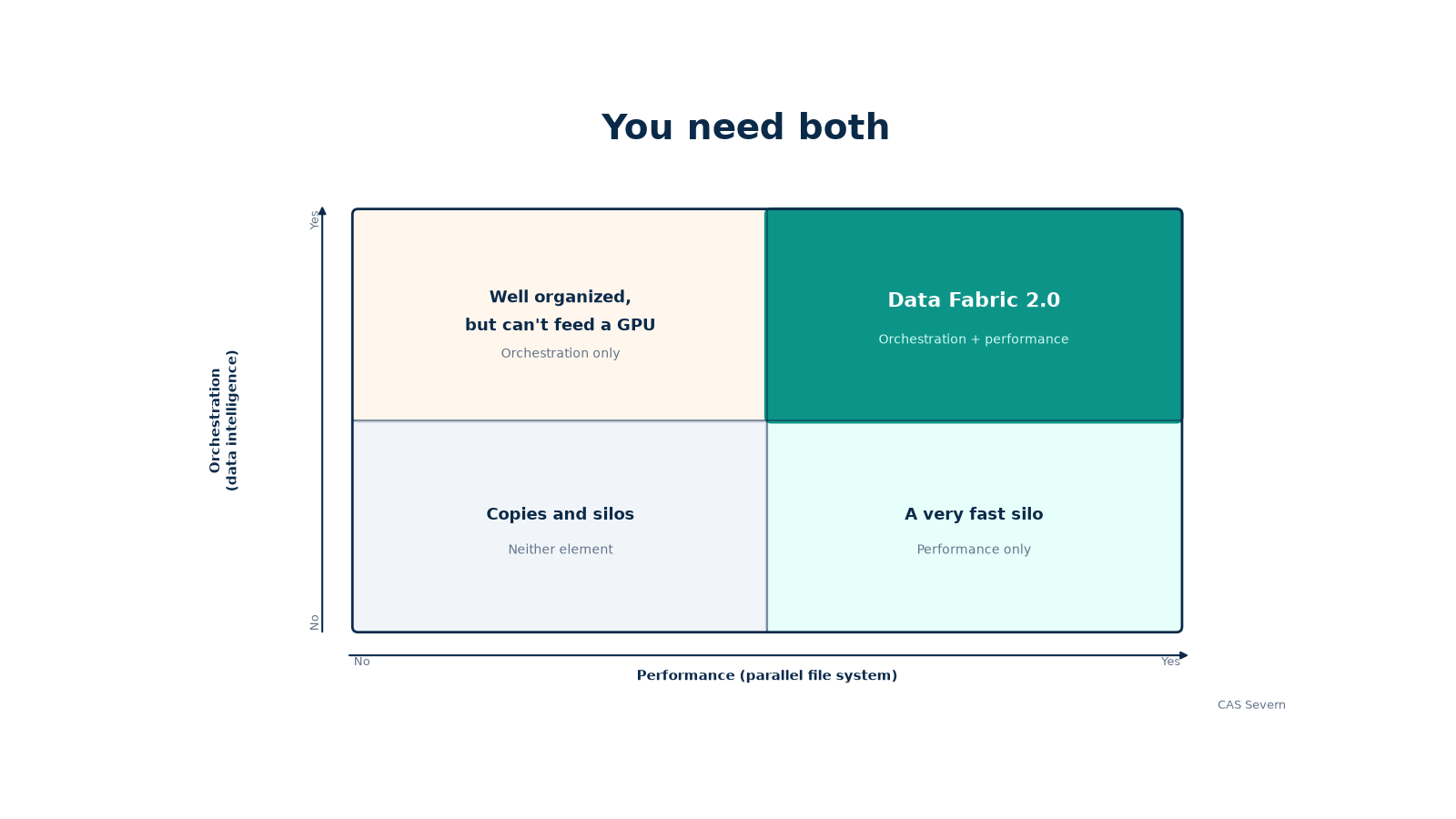
YOU NEED BOTH
- Orchestration without performance: well-organized data that can’t feed a GPU cluster
- Performance without orchestration: unmanageable complexity in a very fast silo
- Both together: Data Fabric 2.0
Dell: an orchestration engine joins the portfolio
In December 2025, Dell agreed to acquire Dataloop, an Israeli company whose platform manages, labels, and processes unstructured data for AI. Press reports put the price at about $120 million in cash. By March 2026, Dell had folded the technology into its AI Data Platform as the Dell Data Orchestration Engine, which Dell says discovers, labels, enriches, and transforms data into governed, AI-ready datasets.
That’s the orchestration element. Dell has also introduced the Dell Lightning File System, a new parallel file system aimed at large-scale AI training and inference. Put those together and you can see the two-element pattern taking shape in Dell’s portfolio.
We’re already fielding questions about both, and we expect to deploy them with some of our most strategic higher ed customers.
NetApp: INSIGHT 2026 and two acquisitions
NetApp made the case loudly at INSIGHT 2026, held September 29 to October 1 in Las Vegas. The big theme was making existing data usable for AI and agents without copying it. NetApp said its AI Data Engine can now discover and understand data across NetApp and non-NetApp storage, so AI agents can work with governed data where it already lives.
The deals line up with both elements. In July 2026, NetApp completed its acquisition of DataPelago, which brings GPU-accelerated data processing close to the storage layer and supports NetApp’s zero-copy approach to getting data ready for AI. Then on September 25, four days before INSIGHT opened, NetApp announced its intent to acquire PEAK:AIO, which builds metadata services and parallel file system technology designed to help shared storage scale alongside growing GPU clusters. That deal is still pending and subject to customary closing conditions and regulatory approvals.
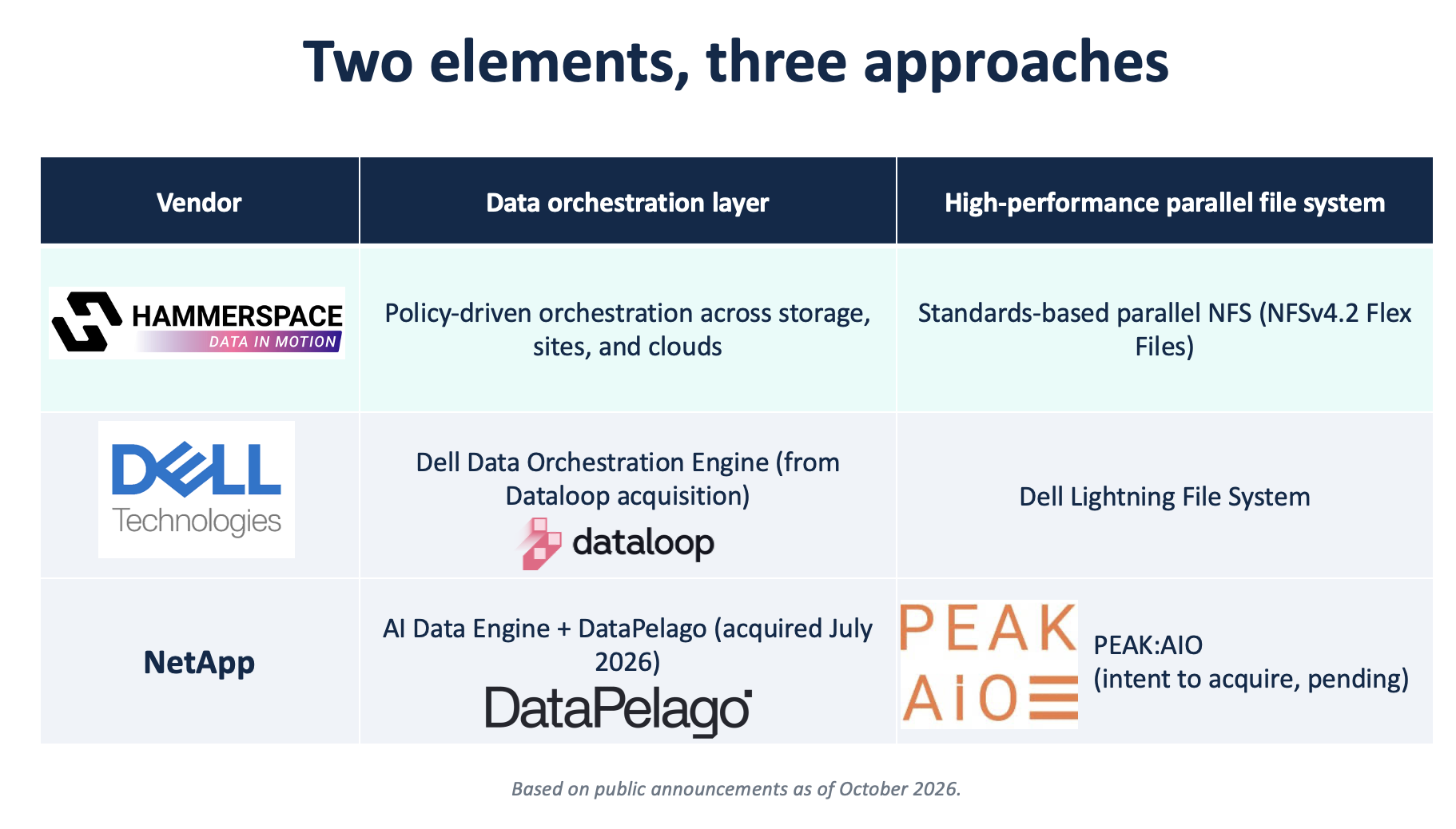
When two of the largest names in storage invest this heavily in orchestration and parallel file access, it tells us Hammerspace has been on the right track, and that the customer problem we started on years ago was the right one to chase. We’re glad two of our top partners now have comprehensive solutions we can offer to our joint customers.
What this means if you run research or public sector IT
- AI can be the catalyst for solving longstanding sharing problems. If teams are redoing work because they can’t reach existing data, AI turns that into a problem you cannot ignore. It also creates a funding mechanism to fix it.
- Check for both elements. Ask any platform how it handles orchestration, how it handles parallel performance, and how well the two work together.
- Count your copies. Every duplicate dataset is a cost, a security exposure, and a version-control headache.
- Respect your boundaries. In regulated and high-security environments, a fabric must work within classification levels, enclaves, and access policies.
An exciting time to be in the middle of it
We’re thrilled to be in the middle of this shift alongside three of our top partners: Hammerspace, Dell, and NetApp. We also work with other leading storage technologies, including IBM, Weka, VAST, and Everpure, and we’re glad to see so much engineering talent focused on the same problem.
Let's build your DataFab at Google PS Summit, SuperCompute, or GTC DC
If you’re looking to accelerate your DataFab ambitions, book some time with me, send me an email or a LinkedIn message, or let’s plan to meet at an upcoming event:
Google Public Sector Summit. October 20, 2026, Washington, DC.
SuperCompute 2026. November 15 to 20, 2026, Chicago, Ill.
NVIDIA GTC DC. December 1 to 3, 2026, Washington, DC.

At CAS Severn, our goal is to provide our customers with insight and best-in-breed technology so they can meet their goals for growth and success. We pride ourselves in our long-term relationships with our clients and completely embrace our roles as trusted advisors for their IT environments. Committed to providing our clients with the right solution for their individual needs, our job is not done until our customers’ problems are solved.
Solutions & Services
Contact Us
Headquarters
6201 Chevy Chase Drive
Laurel, Maryland 20707
800-252-4715
© 2026 CAS Severn | All Rights Reserved | Privacy Policy